What you should know about: Children’s Eye Health | Waterloo Eye Institute
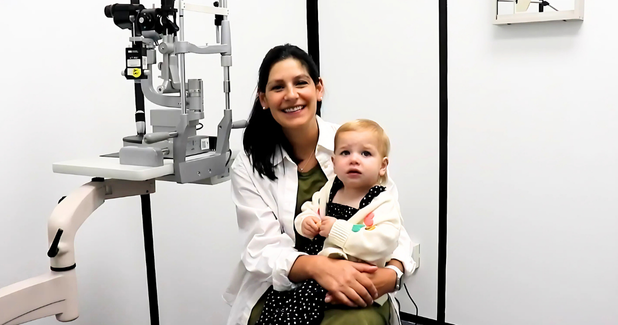
The next part of the eye exam is examining the health of the eye. Specialized magnifying lenses help the optometrist view the structures of the front and back of the eye. For a better assessment of their eye health, your optometrist may want to dilate your child’s eyes. Every child should have a dilated exam at some point in their early years. Dilation is a very safe procedure which allows the optometrist to see into the back of their eyes more thoroughly and get a more accurate measurement of the refractive correction (glasses prescription).
What are common vision problems and conditions in children?
Several eye health conditions commonly seen in children are also seen in adults. These include the following:
- Conjunctivitis (pink eye), which is irritation of the white part of the eye usually caused by allergies, irritants, or an infection.
- Stye, which is an infected oil gland or eyelash follicle that results in an irritated, sometimes painful bump and swelling of the eyelid.
- Chalazia, which is a painless bump caused by a blocked meibomian gland.
The most common vision problems in childhood fall into two categories. These are:
- Refractive error, which means vision is blurry because a clear image isn’t focused on the retina. The most common condition in children is myopia, or nearsightedness, though some children have hyperopia, or farsightedness.
- Binocular vision conditions, which occur when both eyes aren’t working together in unison even with the use of glasses or contact lenses. The two most common binocular vision conditions are amblyopia (lazy eye) and strabismus (eye turn). There are other types of binocular vision conditions too. For example, accommodative issues occur where the focusing system of eyes is not working properly, causing blurriness when shifting focus from near and far objects, such as when copying from the board in school.
These conditions are often carried into adulthood but they usually arise in childhood. The earlier they are treated, the less likely they are to worsen and the more likely a child is to succeed in every day life.
Amblyopia and strabismus
Vision involves visual information being pieced together from both eyes into a singular image in the brain. This is a very sophisticated system and sometimes the eyes aren’t able to work together accurately.
Strabismus is often called an eye turn because it describes a misalignment of the eyes; one eye would be focusing and doing more of the work, while the other eye is turned in another direction, not fixating on what it should be looking at.
Amblyopia, often called lazy eye, occurs when some patients appear to have normal eye movement, where both eyes move and fixate together, but the brain is only using one eye for most of the visual information it is receiving, while the other eye has reduced vision. An eye exam is critical in determining whether your child has amblyopia, because they may not even notice that they have a weaker eye when the stronger eye is doing the work to compensate. If your child has amblyopia, your optometrist may recommend glasses or contact lenses, and other treatments which allow the brain to practice using the weaker eye, improving vision and control. This may include patching the stronger eye.
Strabismus and amblyopia can sometimes occur hand in hand, where the brain has adapted to turn one eye “off” to eliminate the confusion when the eyes aren’t working together.
Myopia
Myopia is the most common eye condition among people of all ages. For people with myopia, close-up vision is clear, but distance vision is blurry. This is why it is often called “nearsightedness”.
Many people have mild myopia, where their distance vision is slightly blurry. However, some forms of myopia develop in childhood and progress rapidly. This is called progressive myopia. As distance vision becomes worse, later-in-life risk for conditions such as macular degeneration, retinal detachment, macular holes and other vision-threatening conditions increases.
In recent years, research advances have led to the development of myopia management techniques that can slow down the progression of nearsightedness. Now considered the standard of care in childhood, myopia control treatment involves the use of special eyeglass lenses, contact lenses or medications.
What signs and symptoms might indicate a child is experiencing vision problems?
After they reach a certain age, children can express if they are having difficulty seeing the board at school or reading up close. When children are younger and unable to articulate their visual experiences, parents and educators can observe certain behaviours that can indicate if the child is having difficulty seeing. Some of these behaviours include:
- Excessive clumsiness can indicate that a child is having difficulty with depth perception.
- Covering an eye or leaning over a desk at one side can indicate that they may be compensating for double vision.
- Some children may have difficulty looking between a board in the distance and then looking down to write on a paper close-up.
- Complaining of headaches can indicate that they may be experiencing eye strain caused by a binocular vision condition.
What lifestyle changes can encourage healthy eye and vision development in children?
Frequent eye examinations are the best way for parents to know if their children’s eyes are developing as they should.
At home, parents can prevent or limit digital device use to promote healthy eye development. Digital devices have been proven to affect vision in multiple ways. Looking at objects at one distance for long periods of time can cause or worsen binocular vision conditions. Time spent indoors on devices instead of outdoors has also been shown to increase myopia risk.
A healthy lifestyle that includes physical activity and a well-balanced diet is not only good for your child’s overall health and well-being, but also fosters healthy vision and eye health.
Waterloo Eye Institute patients
At the Waterloo Eye Institute, our Primary Eye Care Service welcomes children aged six months and older. Our optometrists and upper-year optometry students are equipped to perform full eye examinations where they will assess your child’s vision and eye health, whether your child is old enough to speak and read or not.
Learn more about pediatric eye exams.
In Ontario, the Ontario Health Insurance Plan (OHIP) covers all children 19 years old and under for one full eye examination every 12 months. If your child is determined to have an eye or vision problem, follow-up assessments are also covered by OHIP.
George and Judy Woo Centre for Sight Enhancement
If your child is determined to have a binocular vision condition, your optometrist may choose to refer them to the Binocular Vision Service, which is located within the George and Judy Woo Centre for Sight Enhancement.
There is significant evidence to suggest that many people with binocular vision conditions, including amblyopia and strabismus, benefit from treatment beyond glasses or contact lenses, such as vision therapy. This entails certain exercises and activities that are performed in the clinic and also at home to help strengthen the connection between the eyes and brain and ultimately help your eyes work better together to improve binocular vision. This is especially effective for school-aged children, whose brains are still developing.
link